
Welcome the Shadow

Content Warning: Mentions of suicide & depression.
I’ve been thinking a lot about time markers this season. Living in the heart of empire, time is meted out in dollars earned and spent, bill due dates, units of productivity, and unencumbered growth. As Octavia Butler said, “God is change,” and a part of me wonders how time plays into the spiritual equation. What is change if not time pressing itself against a form, shaping it anew? Change cannot happen without time.
2025 moved so much faster than my body and spirit could process. The rupture of spring and explosion of summer brings a frenetic energy, especially if you live in Chicago—we know how to be outside! We hop from one outdoor gathering to another—birthdays, travel, concerts, barbecues, spontaneous eruptions of connection. While it is a blessing to have so many moments of celebration, I often wonder, when do we really rest? When do we find time to reflect?
As the fall equinox arrives, my body and spirit crave a slower pace, to savor a bit more, breathe more spaciousness into my days. The shuttering of daylight into darkness pulls me into the shadows of myself. Paradoxically, this is when the outside world feels like it ramps up. Even as nature starts to decelerate, we are encouraged and sometimes expected to party! celebrate! optimize! spend more! This pressure infiltrates our families, workplaces, social circles, and even our inner selves.
Every fall, I have tried to keep pace, giving myself pep talks to stay in the grind, even as the chasm between my being and the sun-soaked cheeriness widens. By the time March arrives, I feel frazzled and short-tempered—just in time for the onset of spring activities.
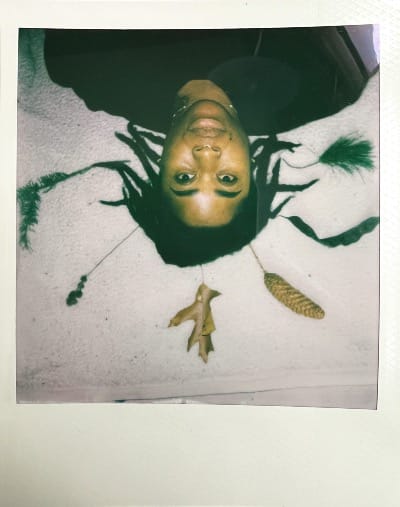
However, something in me has shifted this winter. My body feels rebellious. Defiant. I yearn for a different way to mark time. I feel Spirit’s invitation to listen, to attune to what my body can teach me through wintering. At first, this recognition came as a timid spark. Perhaps it was the cumulative impact of therapy, journaling, reading, five years of sobriety, and many unexpected teachers that had prepared me to embark on a different path.
In the storybook version of my life, this realization is the magical moment™ that aligns everything. I can understand my sadness more profoundly and am able to shape-shift into the next phase, painlessly, with no hair on my chin disturbed. The reality has more rough-hewn edges. As a struggling-to-recover perfectionist, I intellectually understand life is forever experienced in the messy middle. Heavy, heavy emphasis on forever. But the recognition is only a step on the journey. I needed to feel the energy of wintering, to stop denying the urge to break apart or the insistence that it should be tidy.
“Plants and animals don’t fight the winter; they don’t pretend it’s not happening and attempt to carry on living the same lives that they lived in the summer. They prepare. They adapt. They perform extraordinary acts of metamorphosis to get them through. Winter is a time of withdrawing from the world, maximising scant resources, carrying out acts of brutal efficiency and vanishing from sight; but that’s where the transformation occurs. Winter is not the death of the life cycle, but its crucible.”
― Katherine May, Wintering: The Power of Rest and Retreat in Difficult Times
Inviting in the shadow
Honoring my body's timeline has proven challenging. In previous seasons, I have understood this darkness as depression, the feeling of being pushed to the very edge of my being. I have been so afraid that this time, it would be the same, like wearing a veil that separates my soul from my body. Plagued by a fear that has no face, just a vacuous form that follows me everywhere.
As the days grew shorter and the nights stretched on, the familiar fear clawed louder. I could see the jagged cliff, and my legs were on autopilot, shuffling towards the edge where shadow has no limit.
In a late fall therapy session, my therapist asked me, “What do you think lies in the darkness?” My internal response was visceral, my brain sounding the alarm: DANGER! WARNING! DO NOT PROCEED!

Despite the overwhelming sense of dread and anxiety her question produced, a flicker of curiosity also emerged. I have never thought to venture into the darkness. To welcome winter. My past experiences had only taught me to avoid it at all costs because it inevitably leads to suicidality. The fear piled up, growing higher and higher because it was the only story I could access for years. In some ways, I understand that the fear was part of my survival. But now I wondered what other feelings this fear has eclipsed?
We are conditioned to avoid sadness, discomfort, grief, and despair, neatly filing them away for later—or never. Anything that could be perceived as “negative” is often soothed through numbing activities that encourage overconsumption—doom scrolling, mindless eating, use of alcohol, sex, and mind-altering substances, shopping sprees, etc. Against the backdrop of lengthening nights and dropping temperatures, it is no surprise then that a capitalist culture would push us towards overconsumption as an antidote to despair and fear, no matter how temporary.
I left that therapy session knowing I needed to ask new questions. I needed to get curious about my shadow. So I asked Spirit: What is this darkness trying to share with me this season? And I let the invitation scatter like seeds, starting with my breath, feeling it radiate outward like a burst of light through my body. I was calling on a sense memory of another possibility, casting a spell for a world beyond the false promise of capitalism.
“Do not confuse darkness with badness, or evil. Darkness is the residence of all liminal spaces: the womb, the cave, the unacknowledged wisdom that is your task to unearth. Your ancestors have provided you with the tenacity to be here today, to tend to your own heart—and you also cultivate fortitude of heart by living the life you have right now.”—Pixie Lighthorse, The Wound Makes The Medicine
I followed Rilke's invitation to live in the questions that have no answers. When I felt tears bubble up, I didn’t try to swallow them down; I let myself ugly cry every time. Big, weeping sobs with dribbling snot that's a whole-body release when it’s over. I’ve had to be vulnerable with myself, to be brave enough to let sorrow stay without being rushed or minimized.
I am learning to trust myself with my own heartache. Not to belittle it, but to take it seriously. I keep showing up for my body through movement, even when I expected it would immediately help me feel better (it did not). I’ve read books about wading through sadness—currently on The Wound Makes the Medicine. I’m pulling out the sun lamp, taking extra vitamin D, slowing down on caffeine, and chasing the little pockets of sun that escape in front of gray clouds.
I invite it all to fortify me.
Nature as teacher, nature as kin
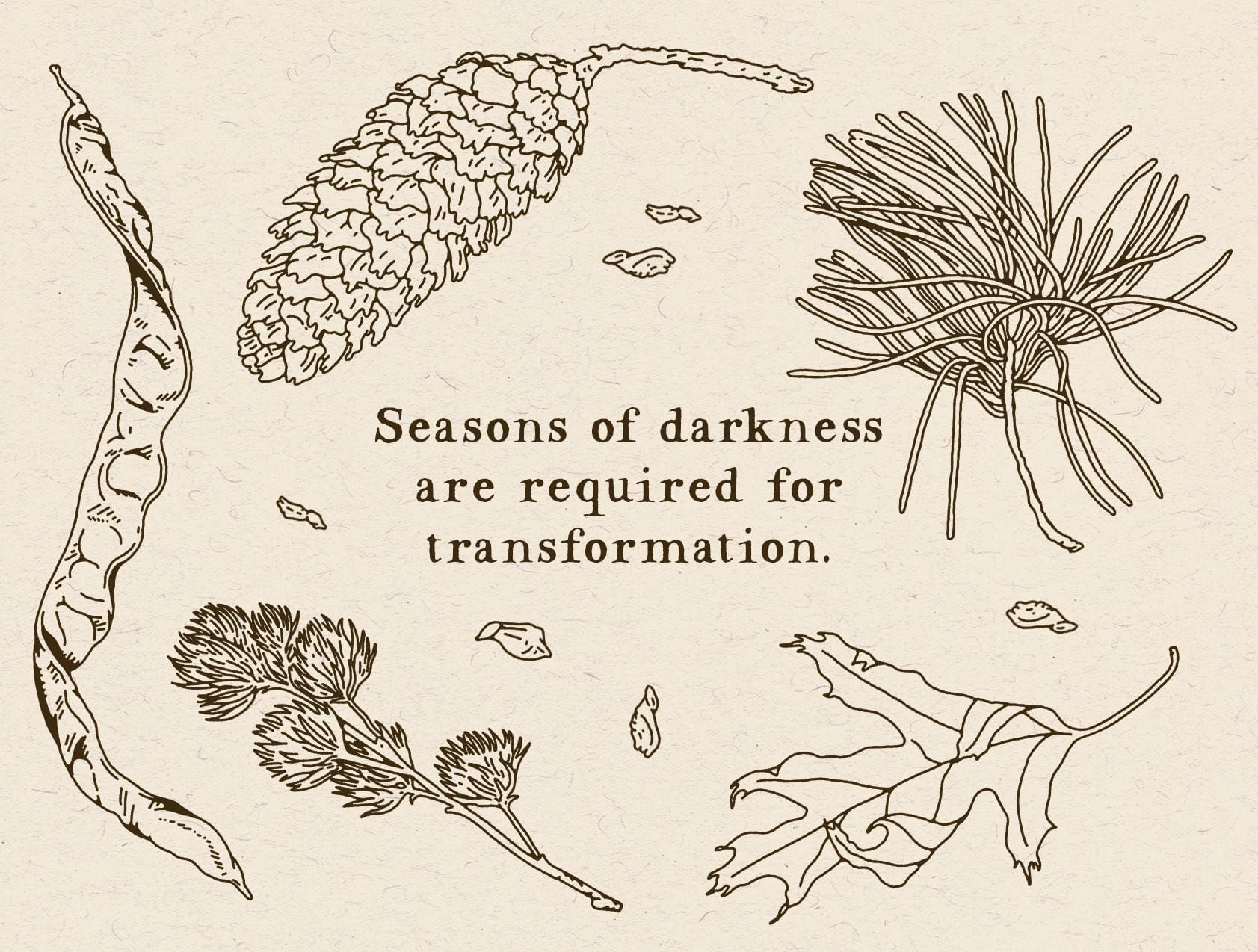
The shadow asked me to connect with the parts of myself rooted in nature. To curl up on the ground and notice the soil. To see that what is happening in nature is happening in me, too. Plants leave precious remnants of the previous season as dried stalks, berries, leaves, and exploded seed pods—shades of brown, sand, burgundy, and ember that become a source of nourishment and shelter during a time of scarcity for insects, birds, and small mammals. Along waterways, roots form a protective layer between land and water, providing shelter for turtles as they weather the cold. Below naked branches, in the understory of trees, life slows but does not stop. Soil-dwelling animals, like frogs, snakes, and gophers, burrow beneath the layer of frozen soil. Fungi continue the work of decomposing organic matter and sharing nutrient messengers of survival between their plant communities.
I am learning to let go of the expectation that all of these acts of self-preservation mean that someday I’ll be “fixed” or return me to a version of myself that is “more presentable or palatable”. Capitalism demands our endless replication and reproduction, and I am releasing the delusion that I ever belonged to the machine.
In truth, I never did.
Instead, I recognize myself in the changing current of winter’s decomposition and the promise of reemergence. I was never broken, even in the shadows. The tension I feel results from looking for belonging where there was never room for all of me.
I belong to nature. I cannot “conquer” the shadow. The carcerality of capitalism is in opposition to the spiritual practice of wintering, of stretching into deliberate slowness, allowing decay to steward transformation. I am practicing creating new time. I am practicing finding solace in heartache.
While the part of me that craves assurance is still learning to accept that there is no perfect concoction that can skip or hasten the process of wintering, I feel myself opening to new truths. I trust that even though parts of me want to disappear during wintering, another part of me that’s connected to everything wants to keep on living. I started calling it self-trust, but now I think it’s more expansive. It is trust in myself, yes, but it’s also trust in my ancestors, my kin, wind prayers, the fleeting first-spring ephemerals, or a chance encounter with two cardinals trading stories on my porch, and in my body carrying out functions to keep me alive without question.

And somewhere in the midst of these foggy realizations, I heard Robyn’s newly released song, “Dopamine”, and for the first time in a long while, I cried with joy and relief. I danced, and my joy ricocheted through every cell in my body. I played it over and over again, unbelieving that music could be a tether back to shore. Of course, music is a tether! Yet, when adrift, it’s hard to remember that safe passage is possible. It felt like my first deep inhale in months.
Nature teaches me that going inward, putting my energy towards deepening my connection to the parts of me that touch darkness, is imperative. Darkness isn’t my enemy. The shadow does not always signal danger. Sometimes it is yearning for us to dig deeper. To believe that the shadow is a worthy companion, offering us new possibilities if we are still enough to receive its message.
To notice, to practice stillness, going outwardly dormant while we tend to inward growth, is a practice of defiance. Through this attunement, we create new possibilities that defy the machinations of empire. It is imperfect; I am still in process, unraveling and rearranging.
There is something profoundly hopeful in this mess. If I am unfinished, then you may be, too—and so too, is our world. There lies a promise that we can create a world that honors our winters, protects our boundaries, and creates spaciousness when our spirits need to expand.
May the soil nourish you exactly as you are today and support your transformations yet to come.

Mutual Aid Donations: Last quarter (Oct-Dec 2025), your support generated $1,524.56 in store profits. I donated $1,501.30 (minus platform fees & tips) to various mutual aid organizations. You can check out the donation receipts here.
Newsletter name change to Still Unfurling! I spent way too much time anxiety spiraling about whether I should talk about the change at any given length. The name is inspired by a Substack essay from Jasmine over at Sugar From Sun. The essay is beautiful, and I def recommend you give it a read if you’re interested. Unfurling speaks to the continual process of becoming, relishing in slowness, and existing in the messiness. As someone who is sometimes desperate for a clear-cut answer to LIFE, unfurling feels like an invitation to curiosity and grounds me back in myself and nature.
Thank you to every person who continues to support my art and writing practice. This publication is free. You can support my work and ongoing mutual aid efforts by purchasing my art or sharing this newsletter.